Showing posts with label eastside. Show all posts


After a busy spell at work and a glorious week and a half away on vacation, I’m back in the saddle again. It looks like I missed another bomb scare, and...well look at that, they finally tore down the old Bob’s IGA!

Pardon my odd sense of newsworthiness, but this is what I write about, y’all.
The demolition of Bob’s was a foregone conclusion dating from at least a year ago. Still, it prompts me to examine the events surrounding the close of Bob Sowers’ self-titled supermarket on Stimson and Kern, because they say a lot about where Athens, and America as a whole, has been headed.

Sowers’ local chain of three supermarkets folded in December of 2004 due to financial insolvency. Sowers blamed the arrival of Wal-Mart on the grocery scene for the closing, while local rumor countered that he had overextended himself by opening a new store in the Plains at a time when belt-tightening was in order for smaller supermarkets. It seems like both factors contributed, but the debate that emerged in the wake of the closing centered on the relative value of Bob’s uptown location versus Wal-Mart’s lower prices.


A particularly fascinating letter from recent Athens mayoral candidate Ed Baum followed a public exchange by J. Miles Layton and Marshall Lilly. Baum argued convincingly that the closing of Bob’s was another chapter in a national trend to consolidate retail business that began in the 1960s, and that supermarkets the size of the A&P (Bob’s original chain affiliation) put two dozen small neighborhood groceries from an earlier era out of business.

While Baum expressed contentment or at least acceptance of this trend towards distant, isolated shopping districts with megastores, I remain skeptical. The savings for the large retailer are obvious: ship in bulk to a single location and let customers from miles around do the driving. The oft-reported savings to the consumer are less clear, and to see why, I’ll spend a moment playing with one of the Attention-Getting Device’s favorite toys: the story problem.

Let’s begin by assuming that a fictional Mr. E. lives on Maplewood Drive, in the middle of the near east side neighborhood of Athens. Mr. E. is a half mile from Bob’s, a ten-minute walk or two-minute drive. By contrast, Mr. E. lives 1.8 miles from Wal-Mart. It’s a ten-minute drive and walking is out of the question.

How much does it cost Mr. E to travel this extra distance? If he shops twice a week, once to stock up and once to replenish a few perishables or items he forgot, he travels 5 extra miles a week to Wal-Mart, and all of those miles are traveled in his car.

At the current IRS mileage rate of 58 cents a mile, which counts fuel cost and wear and tear on the vehicle, Mr. E spends .58¢x5x52 = $150 extra dollars a year in transport to shop at Wal-Mart instead of Bob’s. He also spends an extra 20 minutes of his week behind the wheel in heavy traffic. If time is actually money, and Mr. E’s time is worth $10 an hour, his trips cost him an additional $173 yearly. If he used to head to Bob’s on foot when he needed a couple of items, he loses the health benefits of walking a mile a week carrying a few pounds of groceries, though he may make up half that distance getting from the Wal-Mart parking lot to the shelves and back! He spends more time per year keeping his car maintained as well. Assuming the average American eats 1500 lbs. of food a year, Mr. E. won’t break even shopping at Wal-Mart unless he saves 10-20 cents on the price of every pound of food he buys there instead of Bob’s.

Keep in mind that Mr. E, like most TAGD constructs, represents a best-case scenario. Residents living in the Mill St., Northside, Uptown and near West Side neighborhoods all sacrifice more time and money shopping out on the strip because they live roughly the same distance away from Bob’s location but further away from East State Street. People living west and south of Athens that work in the city have lost a chance to include a shopping trip in their daily commuting route. In fact, the only clear winners travel-wise are people living directly off E. State or Route 50 in eastern Athens County.

Finally, the supposed convenience of “one-stop shopping” is largely a myth, as anyone who has wandered in confusion through the depths of a modern department store already realizes in their gut. The 11-acre area that the Wal-Mart building and its parking lot covers is equal to the stretch of Stimson that used to be home to not only a supermarket, but a hardware store, natural foods store, thrift shop, a dry cleaner and two coin laundries, bank, post office, liquor store, bowling alley, gas station, law offices, two auto-repair shops, a bike shop, a restaurant and a pizzeria. Many of these businesses are still there, but in the past 8 years many have closed down or moved, leaving vacant storefronts or niche businesses that no longer cater to basic needs: a luxury car dealership, specialty truck accessories, a convenience store that stocks cheap beer at high prices, a sex shop. It is especially ironic that Bob’s is set to be replaced with, you guessed it, a parking lot.


The case I have just made is not an attempt bash Wal-Mart specifically but rather to highlight the hidden costs in the entire model of strip mall shopping that has been advancing since the 1960s. An infrastructure that forces individuals to drive everywhere they need to go is senseless, inefficient, and if global climate change is linked to traffic pollution, extremely dangerous in the long term. The fact that shoppers elsewhere have learned to swallow travel times of over an hour round trip for their groceries is no excuse for us to keep moving in that direction. The Athens I know and love is a visionary place, a place where people think for themselves and make their own rules.

A smarter model for the new millennium might look like this: Athens with a distributed network of eight to ten neighborhood grocery stores whose owners have hammered out a collective agreement with a few large distributors so that distributor, retailer and consumer still enjoy the price savings of bulk shipping, but shoppers have easy access without having to jump in their cars and battle the entire rest of the populace for an aisle and parking space. Imagine a grocery right down the street, where you knew the owner and employees but could still take advantage of those almighty low prices. Now that would be a weekly special.

The following gets into the details of local tax law, complex but still important to any resident of Athens County who cares about how their tax dollars are spent.

In 2006, a local retirement center, the Lindley Inn, sued over Ohio University's plan to give 16 acres of tax-exempt state land to National Church Residences to build a retirement village next to the Stimson Avenue Bridge. OU’s original lease was for the token sum of $1 a year, and lawyers for the competing complex alleged that this amounted to a state institution giving preferential treatment to NCR over its competitors. In response to pressure from the Ohio Department of Administrative Services, OU has raised the yearly lease to $40,000. However, lawyers for the Lindley Inn recently filed another complaint, claiming that OU's land appraisal and new lease amount are still unacceptably low.

I have a related question: is NCR's payment in lieu of county property taxes enough?

In the early days of the project proposal, an arrangement was suggested where NCR would pay a $20,000 fee to Athens County, City and Athens schools to make up for the fact that the development was to be built on tax-exempt land. OU's new yearly lease has sometimes been quoted in the media as being $60,000 when what has supposedly happened is that the $20,000 tax replacement fee is now paid to OU instead of directly to local government, with OU then splitting up the $20,000 between the County, City and school district.1

From a citizen’s perspective, NCR should pay the full amount of property taxes that it would if it decided to develop land elsewhere in Athens County. Any amount below this fair market tax value is in effect forcing the rest of Athens County taxpayers to shoulder the tax burden for the retirement center and its residents, all of whom will apparently be from middle to upper income brackets.¢1 Since 60% of property taxes in Athens City go to the Athens City School System and 30% go towards County services, these entities would stand to lose the most. Also, Athens City does not collect income tax on pensions or retirement benefits2, so without a replacement for property taxes the 200 proposed residents would contribute zero to the city tax base, while the City and County (meaning the rest of us) would be financially responsible for providing them with safety, street & road maintenance and recreation services.

With this in mind, I examined NCR’s tax replacement payment against what four comparable local retirement facilities paid to their respective Athens County tax districts in 2007. By scaling the building area of each facility to the size of NCR’s plans and averaging the resulting numbers, I was able to reach an solid estimate of what NCR’s tax bill should be. To take an in-depth look at the study, complete with spreadsheet calculations, a slideshow of site measurement techniques and hyperlinks to source data, click here.

The annual bill I arrived at was between $80,000 and $220,000, depending on how many stories the retirement center will be (2 or 3 floors will double or triple the total square footage of the development). That’s four to eleven times the proposed tax replacement fee, and this leads me to ask what may be a silly question: Will NCR still pay property taxes to Athens County for the buildings it erects on tax-exempt state land?

If so, then the $20,000 fee OU now plans to charge NCR on the city and county’s behalf replaces tax on only the tax-exempt land NCR is leasing. There is certainly precedent for this type of arrangement, since one of my four comparison facilities, Heritage Commons off Stimson and Kurtz, is a tax-liable structure built on exempt land. Sadly, this explanation appears unlikely, since $20,000 would be more than double the annual tax due on land appraised at 480k.¢2

If, on the other hand, NCR will not be paying taxes on the retirement center buildings, then OU’s fee is far too small, and Athens County taxpayers will be subsidizing the retirement center to the tune of $60,000-$200,000 a year. That’s between $1.2 and $4 million over the next 20 years (not adjusted for inflation, which will increase the loss if the replacement fee stays fixed). It would amount to highway robbery, with the entire county as victim and the cash going directly into NCR’s pocket. Remember that even the government-supported low-income senior center at Heritage Commons pays taxes on its building; the idea that a retirement center for the well-off shouldn't have to do the same doesn't just tilt the playing field against NCR's competition; it also flies in the face of a basic sense of fairness and human decency.

Can anyone help shed some light on this? I find it hard to believe that County and State officials wouldn’t have made a fuss about such a huge tax subsidy if the second scenario is the correct one.

I was pleased to crack open last Thursday's Athens News to discover that The Attention-Getting Device received a mention at the end of a June 5th article concerning a fresh legal complaint which alleges that Ohio University's land lease agreement with National Church Residences constitutes a misuse of state property for private gain.

According to the News, TAGD "appears to have launched only last month, and most of its posts so far have dealt with the proposed retirement home, offering detailed attempts at cost-benefit analysis on the project", a spot-on explanation of what has been covered here up till now. Thanks for the copy, A-News!

So far, I've highlighted the windfall NCR expects to reap from the retirement development off Stimson Avenue and the disaster that I think it would be for east-siders, but what of the third party with a vested interest in the outcome of the project?

There have been three arguments consistently made about how the proposed NCR-run retirement center will enhance Ohio University. The first is that the center will provide on-site learning opportunities for students in the college of Heath and Human Services. I’m not sure this argument carries much weight. The programs in HHS have been graduating successful students for decades without the benefit of such a local arrangement, and if representatives for an existing local retirement facility are to be believed, HHS has never (at least not recently) explored the possibility, which suggests that even they don't view it as a high priority.1

As for the second popular argument, the idea that OU wants to keep its retired faculty in the area for their expertise and continued involvement, I think that the University may be hoping to draw more heavily on its retired profs as an inexpensive teaching pool, but my unscientific observation is that many departments still seem actively engaged in trying to shoo their emeriti out the door. Also, former employees spread out around the country would seem to constitute a much more effective publicity presence than a single enclave, and the task of harnessing them for the institution will simplify as the information age progresses.

So what’s in it for OU?

The major benefit that an OU-branded retirement center might carry is in direct fundraising. It's no secret that University financial planners are looking for bigger sources of private money in an era when public funding for higher education continues to decline. Retired alumni, faculty and staff living in close proximity and connection to a university are likely to make larger yearly donations or, even better, major bequests from their estates.

How much money is at stake? It is important to measure the boundaries of the potential financial benefit that Ohio U. may receive from residents’ gifts. I will now present one method of calculating such a figure.

To keep the math simple, I'll use rounded averages provided by the Ohio University Foundation, OU's fundraising arm: $25 million a year in total gifts divided by 25,000 donors. Using this formula, the average per capita yearly donation to OU is $1000. (click here for a discussion of the limitations of the above formula). Assuming that all 200 grateful center residents will double the amount their gifts would have been otherwise, OU stands to profit around $200,000 a year from the facility, $240,000 if the new land lease is added in.

This figure is underwhelming to say the least. In the scheme of a more than $300 million University budget, $240,000 isn't much money at all.2 It also represents less than a quarter of what NCR stands to make on the development (see related article). OU officials may hope they get better returns from center residents who choose to make large estate bequests, but there's no sure way of knowing whether those bequests will actually be made, and the fact that the center is slated to cater to upper-middle income retirees rather than the very wealthy puts a cap on the size of any bequest OU can expect to receive.

OU's best bet for ensuring that they receive estate bequests from center residents is to include language in the lease requiring that NCR build a true continuing-care facility. A July 2006 Chronicle of Higher Education article on the growing trend of university retirement initiatives suggests that "Communities should include all levels of senior housing: independent living, assisted living, skilled nursing, and dementia care. Colleges that don't build the full spectrum of senior housing may put some philanthropic [fundraising] pursuits in jeopardy."3 The piece goes on to quote industry expert Andrew Carle, director of George Mason University's assisted-living and senior-housing administration program: "If philanthropy is one of the big hooks, why would you put in a place a model that, by definition, makes you kick people out just before they're going to give you money?"4

Currently, a model that kicks people out seems to be just what NCR is planning. They have yet to obtain any state nursing bed licenses, nor have they announced any concrete strategies for doing so. This should serve as a clear red flag to OU planners. Keep in mind also that the new lease agreement still doesn't appear to contain stipulations that NCR limit the amount it charges its residents or that the center work in specific ways to provide internships for OU students in HHS. While these may be much smaller concerns, the picture they help paint is bleak: Ohio University on the verge of entering into a long-term lease agreement with no guaranteed benefits or legal leverage to make its partner honor promises made, a managing company in a position to make $4 for every dollar that OU does (and to demand a bailout in the event of a business failure), and neighbors, including a sizable cross-section of the University's own faculty and staff, that strongly resent the entire project.

A year and a half ago, one University trustee remarked that he was "concerned about the reputation of Ohio University for integrity", suggesting that OU's reliability as a business partner would be called into question if it re-examined NCR's lease after making early commitments.5 I believe the opposite. By going through with this deal without more legally binding guarantees than appear to be in place, Ohio University risks tarnishing its reputation as an institution that manages its assets wisely and its business shrewdly. Once done, that damage will be difficult to repair -- NCR's complex will not vanish once built. It could wind up making something like a 2 million dollar loss on a food service venture seem tame by comparison. I don't think that anyone with experience in the business world will fault OU for stepping gracefully, or even awkwardly, out of the current agreement.

In the past four years, the loudest complaint about the OU/NCR retirement development has been that it would occupy valuable green space currently used by the entire community. This is no idle concern. The Near East Side is one of Athens’ densest neighborhoods and has no park space apart from the river acreage that NCR would be building on (and no, a 1-acre elementary school playground cannot serve the needs of the entire neighborhood). Despite the fact that it has never been intentionally developed as parkland, the current space is far from vacant - it is a place where Athenians go to walk their dogs, play soccer, baseball, golf and frisbee, fly kites, or just sit in the sun.

Perhaps most importantly, the open frontage on the river provides a kind of intangible release valve for the feeling of being hemmed in and urbanized. Many east-siders already express feelings of uneasiness about the encroachment of the crowded, dirty and loud student neighborhoods to the south of Stimson, and up till now the strip of land along the river has provided a haven of peace and quiet. While the NCR development won’t doom the East Side by itself, it all but kills one of its major selling points, and if OU loses the East Side as a viable family neighborhood, it has lost pretty much the only faculty/staff/grad student housing currently within walking or cycling distance of the campus -- and you thought not having attractive in-town retirement options was hurting faculty recruitment!

When the plans were originally unveiled, OU justified the loss of parkland by suggesting that they would replace it with comparable space on the site of Mill Street Apartments, which at the time were scheduled for demolition.1 That site, which is situated directly across Stimson Ave. from the proposed retirement community, was eventually renovated instead. Another suggestion - that land across the river be substituted as recreation space - would require the Stimson Ave. bridge to be upgraded to handle pedestrians and bicycles, which ODOT bridge-building codes may or may not allow.

Boosters of the retirement project have also declared their intention to keep the grounds a community space welcoming to East Siders of all ages.
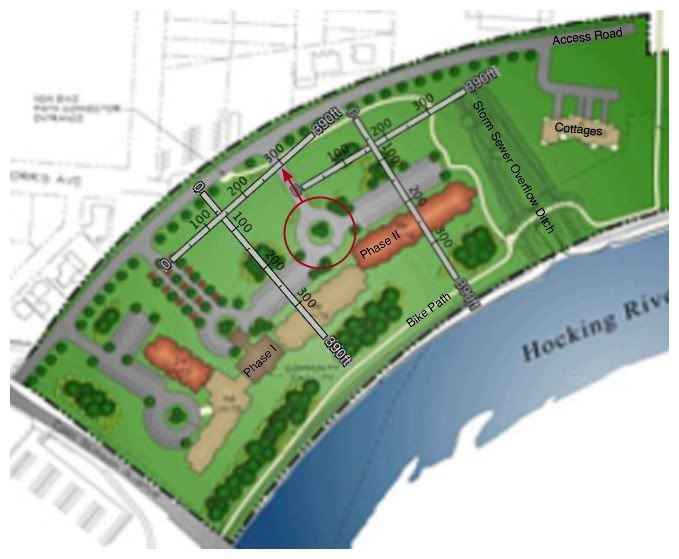
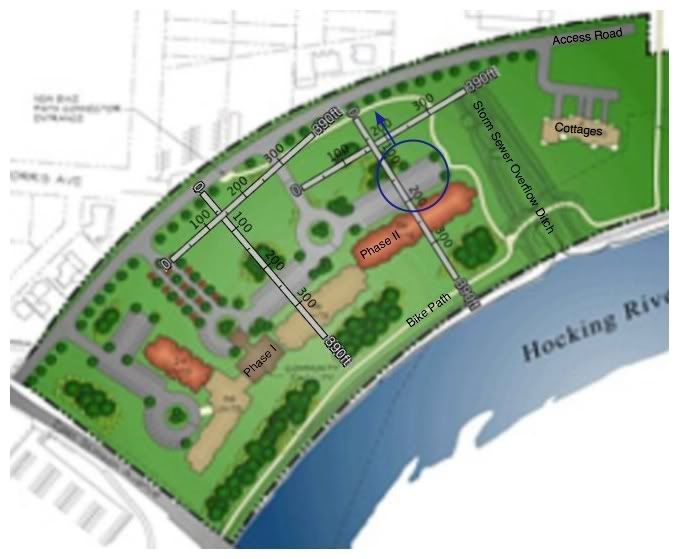
To evaluate this statement I've taken a low-resolution copy of the plans for the retirement project and overlayed it on an aerial photograph of the current land. Here is a version of the plans, from Berardi and Partners Architects’ site:

Buildings in tan represent Phase I of the project, while those in red are part of Phase II. Keep in mind that much detail from the original drawing is lost in an image that is low-resolution. If anyone has access to a higher res version, please send it to me at athwatch@gmail.com and I’ll post it. Click on any image to enlarge it.

Here is the photo of the current site, a screenshot taken on the Athens County GIS data access website (check the “aerial photo layer in righthand “layers” menu):

And here's an overlay of one on top of the other:

There are a number of things I notice right off the bat:

The retirement community buildings are strung in an almost unbroken wall from within 60 feet of Stimson to the edge of the storm sewer overflow ditch, set about 100 feet back from the bike path. They would cut off all view of the river from the East Side and cut off access as well, except by the path that skirts the development next to the ditch. The positioning of the buildings appears designed to give as many retirement center residents as possible a river view from their apartment window while at the same time preserving a sense of privacy from both the bike path and the rest of the East Side -- notice the planned perimeter of shrubbery along the edge closest to Morris and May but within the main access road, leaving the noise and exhaust from the road outside the development. It is a layout that serves the residents of the center admirably but marginalizes east-siders. The only footprint I can think of off the top of my head that would be less community-friendly is if the buildings were positioned in an L-shape around the north and east perimeter of the property, and even then people would at least have clear access to space in front of the river all along the bike path. If the image on Berardi’s website represents the current plans, it appears that the firm didn’t get the memo about designing the development to be welcoming to the larger Athens community.

Assuming the Berardi plans are scale accurate, the entire belt of trees that currently stands behind the old railroad bed east of May Ave. will be taken down to accommodate the access road, placing it unscreened and practically in the back yard of the houses on Meadow Lane. The isolated trees closer to Stimson may be taken down as well, though it isn't clear if they fall in the path of the road or right next to it. Given that the road could easily follow the path of the railroad bed without removing any perimeter foliage, I'm not sure why the site architects made this choice. The fact that the access road in the drawing also extends beyond the eastern cottages towards the library makes me wonder if the project planners have the idea that this road will be connected to Home St. at some point.


The Berardi image also includes the strip of land in front of the Athens Public Library as part of the retirement center tract. While nothing seems planned currently for that space and NCR has pledged not to build directly in front of the library, it concerns me that NCR may be given the legal authority to banish Athenians from this last chunk of open space as well. It's confusing why the acreage, which is mostly owned by the Hocking Conservancy District, was included in the deal if there are no plans to build on it; it seems like the portion of the tract further west that planned construction falls on could easily have been parceled off.

Of the two planned park areas that do exist, the western chunk measures roughly 275’x215’, while the eastern one appears to be roughly 280’x140’.¢1 As far as community recreation space is concerned, a tennis or a basketball court is theoretically possible, though football, soccer, baseball, and driving-range activities are all out of the question since each requires a field larger than 300’ long. These two tracts represent a little space - 14% of the current open land - but space robbed of much of its utility.¢2 A simple change of moving the third drive and traffic circle (image 1, outline in red) to the edge of drainage ditch (image 2, corresponding outline in blue) would join the two spaces and make them much more usable.


Here’s a quick summary of the arguments that have been made for and against the planned OU/NCR Retirement Center:

For:
The retirement center will :

• Keep retiring OU faculty in Athens and assist in new faculty recruitment.
• Increase financial gifts made to OU.
• Serve as a training facility for OU gerontology students.
• Be within walking distance of the Athens Public Library and many local businesses.
• Bring more business into the town.
• Foster a vibrant intergenerational community on the east side.

Against:
The retirement center will:

• Occupy the Near East Side’s only real park space, eroding the neighborhood’s appeal as a residential quarter.
• Increase traffic congestion and hazards on Stimson, Morris and May Avenues.
• Cater only to wealthier retirees.
• Compete unfairly with other retirement centers in the area.
• Drain city resources without being part of the tax base.
• Contribute to risk of flooding throughout the Hocking River Valley.

Photobucket


Development Name:
"Traditions at Ohio University"

Description: Originally billed as a Continuing-Care Retirement Community (CCRC), now talked about as a retirement village for active seniors only.

Planned Location: 16 acres of land off Stimson and Morris Avenues between Near East Side neighborhood and Hocking River, with portions owned by OU, Athens City and the Hocking Conservancy District.1

Managing Company: National Church Residences, the country’s largest nonprofit senior housing provider, founded by a group of Ohio Presbyterian Churches, headquarters in Columbus, OH.

Institutional Backing: OU, under former president Robert Glidden, laid the groundwork for the development in 2004 and University officials continue to be a strong advocates for the project.

Land Lease: Ohio University administrators originally made their portion of the land available for free, setting NCR’s lease at a token $1/year, but after sharp state, civic and legal criticism, OU recently revised the agreement, making it a $40,000/year 40-year lease with a 40-year extension. Athens City exchanged their chunk for a promise that NCR pay $35,000 for a 1/3 acre playground near the Athens Public Library. The lease terms of the Hocking Conservancy District's land have never been clarified in the news media.2


Planned units: 151, mostly one and two-bedroom apartments, 2 2-3 story main buildings, 4 cottages, contructed in two building phases.3

Residents: 200 residents, couples and singles.4

Services: Minimal assisted living, no nursing beds currently planned.5

Cost To Live There: Originally quoted in 2006 as $1500-$2500/month, fee would include one meal per day and local transportation6; NCR representatives have indicated that costs will rise now that the lease agreement is no longer $17.

Medicare/Medicaid Accepted: No in Phase I, Yes in Phase II? Hinges on whether NCR acquires nursing beds for the facility.8

Federal Housing and Urban Development (HUD) Money Accepted: No9

Planned Employees: 3510

Public Support: Mostly among retirees around Athens City with Margaret Topping as spokesperson.

Public Opposition: Mostly from Near East Side residents, with Christine Fahl as spokesperson. A petition against the proposed retirement center garnered 800 signatures in 2006.11

Other Critics: The Lindley Inn, a retirement center in The Plains, claims that OU is giving an unfair advantage to NCR by allowing it to lease public land for under fair market value and filed a lawsuit in 2007, which they later withdrew.12 City Council member Bill Bias manages a competing local retirement facility and has raised complaints similar to those of the Lindley Inn’s lawyers.

Current Status: Ohio University is currently awaiting
Ohio Department of Administrative Services (DAS) approval for the lease agreement.13